Search this question and you’ll find answers ranging from under a
hundred pounds to tens of thousands. That range isn’t a mistake, and
it isn’t different sources disagreeing, it’s different routes to
building a website, each priced very differently, being lumped
together as if they were one answer.
Direct answer: for most UK small businesses, a
professional website costs somewhere between £300 and £3,000 for a
straightforward brochure-style site, depending on whether you build
it yourself, hire a freelancer, or use an agency. Custom builds,
e-commerce, or complex functionality push costs well beyond that. The
route you choose matters more than any single “average” figure.
Here’s what each route actually costs, and why the numbers you’ll
see elsewhere vary so much.
Why website cost guides disagree with each other so much
Most guides quote a single “average cost” without saying which
route it applies to. A DIY builder subscription, a freelancer’s day
rate, and an agency’s project fee are three entirely different
pricing models being compressed into one number, which is why one
guide says £200 and another says £8,000, and both are technically
correct for what they’re describing.
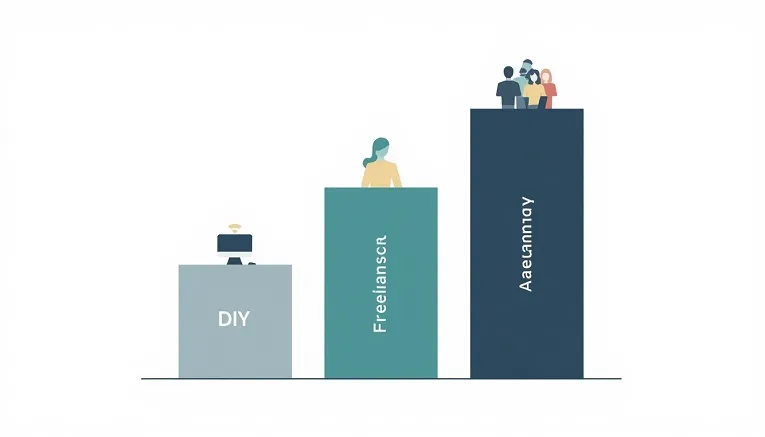
The honest answer needs to separate the routes out. Here’s how
they compare.
DIY website builders
Using a platform like Wix, Squarespace or a similar builder, you’re
paying a subscription rather than a project fee.
Typical cost: roughly £10 to £40 per month, which
usually bundles hosting and a basic level of support, plus a small
annual domain fee.
What you’re really paying for: your own time, in
exchange for a low ongoing cost. Most business owners spend several
weekends building their first site this way.
Best for: simple, low-page-count sites where the
owner is comfortable handling design decisions themselves and doesn’t
need custom functionality.
Freelance web designers
A freelancer typically quotes a flat project fee, sometimes broken
into a day or hourly rate.
Typical cost: roughly £800 to £3,000 for a
straightforward four to five page small business site, with day rates
commonly falling somewhere between £250 and £600 depending on
experience and location.
What you’re really paying for: a custom-built
site without agency overheads, plus direct communication with the
person doing the work.
Best for: businesses that want something more
tailored than a template but don’t need the structure of a full
agency team.
Web design agencies
Agencies typically quote a project fee that includes a full team:
designer, developer, and often a project manager.
Typical cost: roughly £2,000 to £10,000 for a
standard small business site, with regional agencies generally
sitting toward the lower end of that range and specialist or
metropolitan agencies toward the higher end.
What you’re really paying for: structure,
accountability, and a team rather than a single point of failure. If
a freelancer is unavailable, your project stalls; an agency has more
built-in resilience.
Best for: businesses with a larger scope, custom
functionality, or who value the reliability of a full team over the
lower cost of a solo freelancer.
Cost comparison table
| Route | Typical cost | Ongoing cost | Time investment (you) |
|---|---|---|---|
| DIY builder | £10-£40/month | Included in subscription | High (you do the building) |
| Freelancer | £800-£3,000 project fee | Hosting + occasional updates, often £100-£300/year | Low to moderate |
| Agency | £2,000-£10,000+ project fee | Often sold separately as a retainer | Low |
These are general market ranges drawn from typical UK pricing
patterns, not a fixed quote. Get a proper quote from a couple of
providers before budgeting, since your actual figure depends heavily
on scope.
What actually drives the price, whichever route you choose
- Number of pages. More pages means more design
and content time, regardless of route. - Custom design versus template. A fully custom
design requires strategy and layout work a template skips entirely. - E-commerce functionality. Product listings,
payment integration and stock management add meaningfully to cost on
any route. - Copywriting and photography. If you need your
text written or your images shot professionally, that’s frequently
priced separately. - Ongoing maintenance. Almost every route has a
recurring cost beyond the initial build, whether that’s a
subscription, a hosting bill, or a retainer.
A realistic budget by business type
| Business type | Realistic budget |
|---|---|
| Sole trader, simple brochure site | £300-£1,500 (DIY or entry-level freelancer) |
| Small local business, 5-8 pages | £1,000-£3,000 (freelancer or small agency) |
| Growing business needing custom functionality | £3,000-£8,000 (established freelancer or agency) |
| E-commerce with more than a handful of products | £3,000-£10,000+ (agency, or an experienced freelancer specialising in e-commerce) |
Questions to ask before you accept a quote
- Does this figure include copywriting, or am I supplying the text
myself? - What’s included in ongoing costs, and what counts as a separate,
billable change? - How many rounds of design revisions are included before extra
charges apply? - Who owns the finished site: can I move it to another host or
developer later if I need to?
Being clear on scope from the start is the single biggest factor
in avoiding a quote that grows once work begins. If you haven’t put
your requirements in writing yet, our guide on what to include in a
website design brief will help you scope the project properly
before you ask anyone to quote on it.
FAQs
Is a cheap website worth it for a small business?
It can be, for a genuinely simple site with modest goals. The risk
with very cheap options is usually limited flexibility and weak
ongoing support, so weigh the low upfront cost against what you might
need to change or add later.
Do website prices in the UK include hosting?
Sometimes, but not always. DIY builder subscriptions typically bundle
hosting in. Freelancer and agency project fees frequently don’t, so
check whether hosting is a separate, ongoing cost before you compare
quotes.
How much should I budget for a website every year, not
just upfront? Beyond the initial build, budget for hosting,
domain renewal, and either your own time or a maintenance contract
for ongoing updates. For most small businesses this lands somewhere
between £100 and £500 a year, more if you’re paying for professional
maintenance.
Is it cheaper to build a website myself? In
upfront cost, yes. In time, not necessarily, since most business
owners underestimate how many hours a DIY build actually takes,
particularly if design isn’t a skill they already have.